My Baby Steps to Becoming a Professional Trader
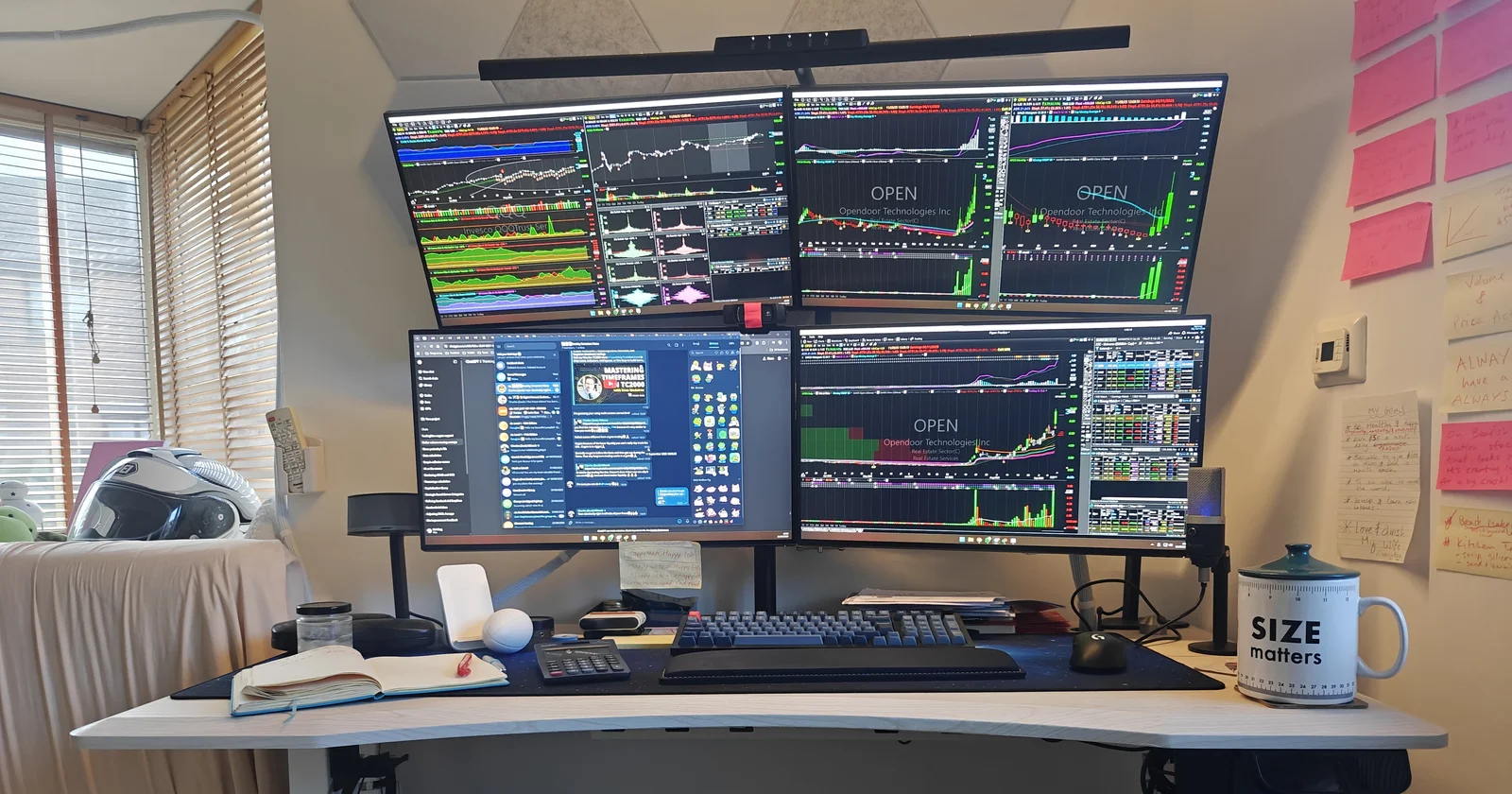
It’s been over 3 years since I started this journey. Two years of intense learning. One year of intense building, which turned everything I’d picked up into an automated trading platform with a simple (not so simple) MVWAP strategy and a workflow that’s almost fully automated. Almost. I kept a human in the loop for the actual trade entry decisions, on purpose. If you want the build side of that story, it’s over here: Building a Production-Grade Trading System with Claude Code.
This post isn’t about the build. This post is about what it took to learn what I know now. Which isn’t a lot. But it’s still an ongoing journey.
How I Got Into Trading
A long long time ago, probably over 12-13 years ago, I tried to get into trading. I was at a turning point in my life with a fresh start. I spent about a year reading and learning, but at that time I was lacking capital, which is kind of challenging when you’re trying to trade without money lol. So that attempt didn’t get too far.
It was only when COVID happened (just over 6 years ago now) that I started dabbling in stocks. Not quite trading yet. Just buying things and holding.
Then 3 years ago, another turning point. Full circle. This time I had more capital that I could trade with, and more importantly, I wanted to learn something I could do alone. No team to build. No boss telling me what to do. No clients to manage. I was tired of a 10 year career in IT. Tired of 20 years running my own businesses. Tired of the taxes and the admin that comes with all of it. I was totally burnt out with life itself. It was a tough period. Was I happy? No.
So trading. I thought yeah, it ticks a lot of boxes. I want to be alone. I want to work alone. I want to make decisions for myself that don’t affect others.
Strategy One: Qullamaggie
A friend told me about Qullamaggie. I read his website inside out, watched all his YouTube videos, and got myself a TC2000 Gold subscription (which I later upgraded to Platinum once I started experimenting more and got hungrier to play around with the premium features).
That was my first taste of swing trading. The setup is: you enter on pullbacks and bounces off the 10 EMA (Exponential Moving Average), 20 EMA, or 50 MA (Moving Average) lines, when there’s an Episodic Pivot setup, which is when a stock starts moving fast and surging in dollar volume. You hold positions for 1 to 3 months, and exit based on pricing closing below the key moving averages. Qullamaggie also touches a little on market conditions, using moving averages on the SPY or QQQ (the two big US index ETFs that traders use as a proxy for market direction). I’m not going to go into the details. You can go to his website and learn it. I’m not here to teach you how to trade. There are tons of materials out there already.
Here’s the bit that surprised me. Copying someone else’s strategy isn’t too hard. The hardest bit is understanding how it works, why it works, and when it works. The “what” is already answered, because Qullamaggie and many others are living proof of it.
Thankfully someone on YouTube has collated his best videos and cut out the noise. Just search “qullamaggie” on YouTube and you’ll find it. Even then, sitting through 1-3-6 hour long videos can be quite a brain fry. So if you’re struggling, search for qullamaggie explained by Jack Corsellis. That guy explains it pretty well, from his interpretation. Read what I wrote, his interpretation! It’s not Qullamaggie’s words. But it’s a great starting point if you’re stuck.
I have to admit, the Qullamaggie strategy works really well. I think I was profitable after about a year and hadn’t blown my account yet.
Strategy Two: Stockbee
Then I thought, are there other strategies? Qullamaggie mentioned Pradeep (Stockbee), so I followed him next. Read everything. Watched everything. Which was much much more material than I thought.
Learned about momentum bursts. Learned about delayed entries for EPs (Episodic Pivots). Earnings plays. Gap-up strategies. Naked charts (no, not me being naked in front of my computer lol, naked charts are just charts without indicators, only candlesticks and maybe volume bars). Learned more about price action and candlestick formations. This is also when I started getting properly comfortable with TC2000, creating my own scans, figuring out what features the platform had to offer. And I started to learn about market breadth.
This is also when my performance started going down. I was experimenting more. My focus wasn’t to make money yet, it was to give myself a 3 year window to learn as much as I could without worrying about the P&L. I think I blew about 30% of my account high during this period. I didn’t use paper money. I wanted to feel the pain of using real money, win or lose, and learn how to control the emotional and mental stress that comes with it. That feeling matters. You can’t learn that from a simulator.
Strategy Three: Scalping (Don’t)
I then spent about 3 months learning to scalp from Ross Cameron at Warrior Trading. It was intense. It taught me to read price action at a much faster pace. It was also when I blew nearly 80% of my account.
It was bad.
I remember after 2 hours of constantly scalping, my brain was burned out and I was dead mentally and emotionally for the rest of the day. It became very very clear that scalping wasn’t my thing. But I gave it a shot to learn what I could, because the goal was always to experience as many different trading styles as possible.
Scalping is an intraday strategy that works nearly every day, because there will always be a stock that moves very quickly. It’s also the strategy that will blow your account very quickly. One thing I’ll say about Ross is, he is insanely good at what he does. I don’t think 0.00001% of people who try to do what he does will succeed. You’re trading against bots, and the bots are replicating what Ross does within milliseconds. So yeah, good luck with that!
This is why I think scalping is a failing strategy for the majority. Not because it doesn’t work. It does work, for Ross. It just doesn’t work for almost anyone else.
The Others
In between all of this, I also studied a bunch of other traders.
- Jesse Livermore (via the book Reminiscences of a Stock Operator). Classic for a reason.
- Mark Minervini. Similar to momentum bursts, but with much higher concentration and conviction on a single stock.
- Verillo Trading. This is where I learned how to set up Interactive Brokers TWS (the Trader Workstation, IBKR’s desktop platform).
- The Secret Mindset. Super useful for understanding liquidity hunts and sweeps, how the market actually works, and why the strategies the majority of retail traders are taught tend to walk them straight into traps.
And then there were many others I didn’t respect. Especially the ones marketing themselves with whatever the hot trading strategy is this month, promising you’ll make $millions. You can spot them. Every video is a different strategy. That’s how you know someone isn’t a master of their trade. It’s a great list of how NOT to trade.
The One Lesson
Here’s the one thing I’ve learned that I’d actually pass on. It’s okay to learn as many different strategies as you want to get a feel for how trading and the stock market work and which strategy best suited for your personality and lifestyle. But ultimately, pick one strategy and know it inside out. Keep it simple. Both the strategy itself, and how you read the market conditions. Otherwise it’s not repeatable, and it’s very difficult to manage.
KISS. Keep It Simple, Stupid.
Comparing the Three
For anyone curious, here’s how the three strategies actually stack up from my experience.
Scalping. Pros: you can make money very quickly, and there’s nearly always a fast-moving stock to trade. Cons: you’ll lose money quicker than you make it, you need to think and respond like a machine, you’re competing against bots, your account size is limited (you can’t size up properly because you’ll move the price too much on the kind of stocks that surge 200-500% in a day, so you have to keep drawing down from the account to keep it at a tradeable size), and it only really moves at certain times of the day.
Momentum bursts. Pros: compounds quickly, flexible across all market caps so you can dial your risk tolerance, and it works in every market condition (even in a bear market there’s always a small bounce, which is what you’re catching). Cons: time-consuming. You spend a lot of hours looking for stocks that behave predictably enough to trade.
Swing trading. Pros: scales easily as your account grows. The strategy stays the same, only the market cap of the stocks you go for changes. Cons: much longer holding time. Typically 1-3 months per position.
The Missing Piece
So by this point I’d burnt 80% of my capital. It’s enough to say I’d blown my account for the first time, haha. It’s fine.
But it forced me to look at what I was missing. And the thing I was missing was timing. Market timing. About 1.5 years in I was still quite clueless about market conditions, and I was entering at bad times, which chipped away at my account very quickly with every bad trade.
So I spent about 6 months just studying market movements and history, trying to look at it from as many different angles as I could. I’ll probably write a blog about how I read market conditions in the near future, but let’s see. The short version is: I use various indicators, I’ve created my own way of stacking them, and I borrowed a few ideas from Stockbee, including T2108 (the percentage of stocks above their 40-day moving average, which comes native in TC2000 and is one of the cleanest breadth indicators out there).
Where I’m At
Learning trading is fun. It can also be stressful.
Sometimes I look back at all the notes I’ve written, the strategies I’ve turned into slide decks, the tens of thousands of setup screenshots I’ve put into handbooks, the rule books I’ve written for each strategy. It’s serious business. If anyone wants to learn trading, it’s possible. Learning for fun is one thing. Learning because you want to make money from the stock market and want to stay in the game is another thing entirely. That’s serious business.
Like everything I’ve ever learned, I feel I know so little even after investing this much time and money into it. And yet I’ll keep refining what I’ve got.
I wrote this first blog so you know a little about my journey so far. That way I can later skip the intro and dive straight into the more interesting trading thought dumps.
Watch this space.